Semart Stories
From Oven to Opportunity: Syirazi Sharif's Entrepreneurship Journey
Revisit Syirazi Sharif's Bread Mansion story and the practical lessons his reported pivot, production focus and business records offer entrepreneurs.
Semart Editorial Team
7 min read
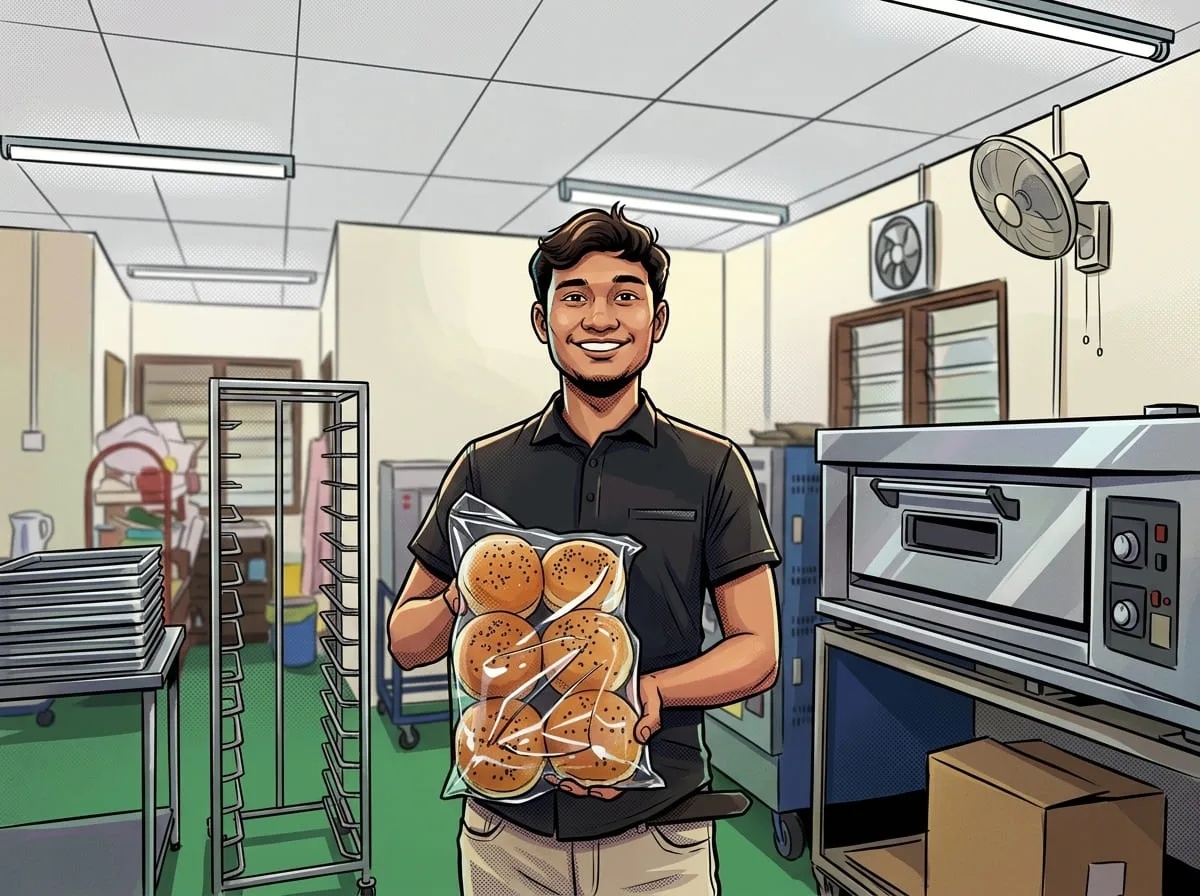
From the Semart archive.
Syirazi Sharif's entrepreneurship journey is a story about narrowing an offer until it serves a clear customer. What began as a broader home-baking effort became Bread Mansion, a business focused on supplying burger buns.
The account below revisits facts reported in 2023 by Yayasan PETRONAS and Kosmo. It is a historical profile, not a statement about the business's current scale, programme participation or use of Semart.
Starting with a product, but not yet a market
Syirazi began by making sweet buns and trying to place them with shops and vendors. The original Semart archive described limited traction from that approach. In a December 2023 Kosmo interview, he said the earlier mix of baked products had produced only about RM50 in monthly profit.
That number belongs to his account at the time, not to an audited financial record. Even so, it illustrates one of the costly small-business mistakes: making something competently does not guarantee that enough customers will buy it at a sustainable price.
A founder can respond by adding more products and hoping one succeeds. Syirazi moved in the opposite direction. He concentrated on a more specific product for a more identifiable buyer.
The pivot to burger buns
Bread Mansion's pivot centred on burger buns. The product matched a recurring need among burger sellers, and the customer group was easier to define than a general market for assorted baked goods.
Yayasan PETRONAS's 2023 annual report described the shift to burger-bun manufacturing and reported production of more than 700 buns a day, distributed across Kedah and Penang. Kosmo similarly reported output of up to 700 buns daily during 2023.
These are date-bound reported figures, not claims about present production. Their value here is what they reveal about the business model. A focused business-to-business product can make demand, batch planning and distribution more predictable.
The lesson is not that every baker should choose one product. It is that a small business should be able to answer three questions clearly:
Who buys this product repeatedly?
Which problem does it solve for that buyer?
Can we produce it consistently at the quantity, price and schedule required?
If those answers are vague, expanding the menu may increase complexity without improving demand.
Finding customers where they already gather
Syirazi's account also shows why distribution is part of the product. The Kosmo report said he promoted the buns through Facebook and the Burger Malaysia community, connecting with operators already using the product he made.
This was more targeted than waiting for general consumer discovery. A supplier of burger buns does not need every social-media user to be interested. It needs the attention of burger sellers with a recurring supply requirement.
Entrepreneurs can apply the same principle without copying the same channel:
Define the buyer by job, business type or recurring need.
Identify the groups, marketplaces or physical locations where that buyer already looks for suppliers.
Offer enough information to support a purchasing decision, including product specification, minimum quantity, lead time and delivery area.
Follow up with a repeat-order process rather than treating every sale as a new conversation.
A narrow audience can be commercially stronger than broad visibility when each customer buys regularly.
Turning a recipe into repeatable production
Moving from home baking to hundreds of units changes the job. The founder is no longer proving that one batch can taste good. The business must produce the same usable result across many batches and delivery days.
Kosmo reported that Syirazi joined a bakery and fermentation programme under empowerNCER in 2023. The reporting provides evidence of training and monitoring, but the older Semart article gave a different date and programme duration. This rewrite therefore does not repeat the conflicting schedule as settled fact.
The broader production lesson remains useful. Training can help, but scale also depends on documented controls such as:
ingredient specifications and supplier alternatives;
dough weight and portion tolerance;
proofing, baking and cooling checkpoints;
batch yield and rejection reasons;
packing and delivery cut-off times; and
customer feedback linked to a production batch.
These controls turn personal technique into a process another trained team member can follow. They also make it easier to investigate a poor batch without guessing.
Using records to support decisions
The original profile connected Syirazi with BeSEMART, a Yayasan PETRONAS initiative supported by Niagable. Yayasan PETRONAS reported that the programme onboarded 50 participants and that 27 were implementing the system in 2023. Kosmo's interview said Syirazi used a dashboard to record orders and expenses and received monitoring through the programme.
This is historical programme context only. It does not establish his current software use.
The durable lesson is that sales activity needs records. A busy production day can feel successful while still consuming too much material, delivery time or unpaid effort. The financial-literacy habits entrepreneurs practise become concrete when a small manufacturer can see:
orders received and fulfilled;
quantities produced and rejected;
ingredient and packaging spend;
customer balances and payment dates;
delivery cost by route;
gross profit by product or customer group; and
cash available for the next purchasing cycle.
The tools can change. The need to compare demand, cost and cash does not.
Growing in stages
In the 2023 interview, Syirazi also spoke about plans to develop his own burger brand. A move from supplying buns to operating a food brand could create a new route to market, but it would also introduce service, staffing, location and finished-product risks.
That makes staged testing important. It is the same layered approach used to build entrepreneurial resilience. Before adding a downstream business, an entrepreneur can test:
one event or limited sales period;
a small menu using existing production strengths;
a fixed capital and stock budget;
separate records for the new activity; and
a clear decision date for continuing, changing or stopping.
The existing supply business should not become invisible in the excitement of a new idea. Its capacity, customers and cash cycle need protection while the next model is tested.
Five lessons from the Bread Mansion story
Syirazi Sharif's entrepreneurship journey offers five practical lessons:
Treat weak traction as information. Review the customer, product and channel instead of only increasing promotion.
Narrow the offer when focus improves repeatability. A clear buyer and recurring need can be more valuable than a wide product range.
Go where the buyer already gathers. Distribution works best when it matches how the target customer finds suppliers.
Build production controls before volume hides the problems. Track batch yield, quality exceptions and delivery reliability.
Use records to decide the next stage. Orders, costs and cash give growth plans a firmer foundation than activity alone.
Opportunity often follows a better definition
The most useful part of this archive story is not the reported daily output. It is the sequence behind it: an early offer struggled, the product became more focused, the route to customers became more specific, and training and records supported a larger operation.
Entrepreneurship is often described as persistence. Syirazi's story adds an important qualification. Persistence becomes more useful when the entrepreneur is willing to redefine what the business sells, whom it serves and how it proves that the model works.
About the author
Semart Editorial Team
The editorial team at Semart Sdn. Bhd.